
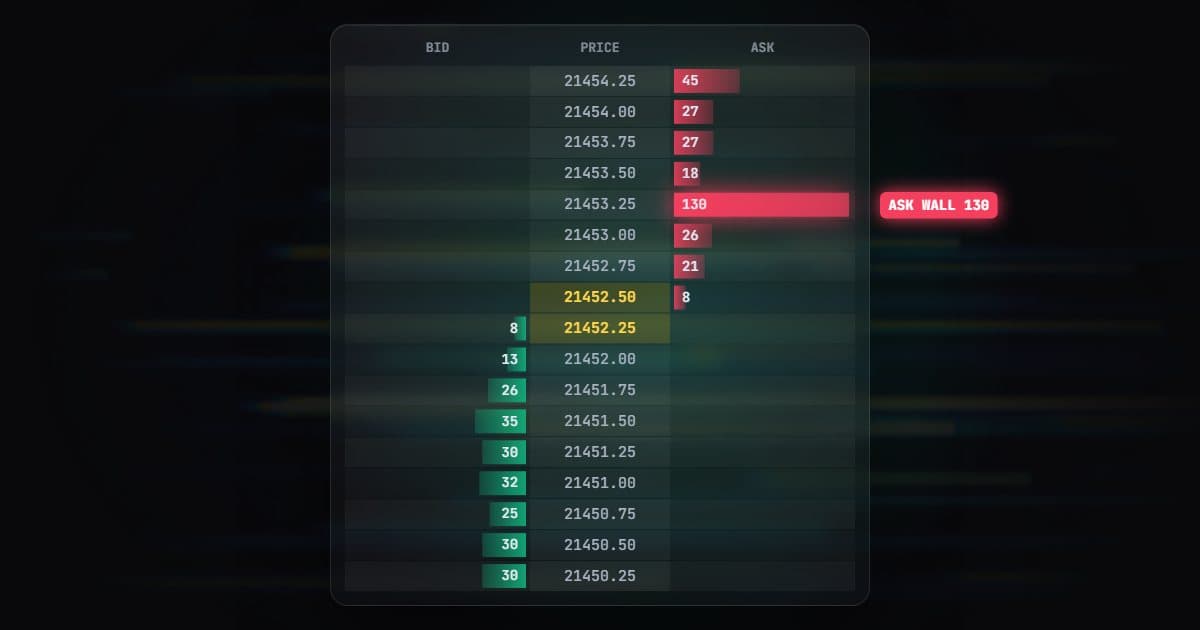
Spotting a lopsided order book is the easy part. Turning it into a strategy means answering harder questions: how lopsided, for how long, what if the size is fake, how you enter, and when you stop. This guide works through those decisions one layer at a time, using the Pressure Break signal in Vantedge BookPilot as a concrete example.
Layer 1: define the imbalance
A strategy needs a precise trigger. BookPilot's Pressure Break adds up the resting size on the first Pressure Break Depth levels of each side (2 by default) and compares the totals. When the bid side reaches Pressure Break Ratio times the ask side (4.0 by default), a long candidate starts. A heavier ask side starts a short candidate.
Both numbers are trade-offs. More levels give a steadier reading, but deeper size is easier to pull. A higher ratio means fewer, stronger signals; the guide notes that below about 2.5 the scanner fires on ordinary book noise.
Layer 2: make it prove itself
A 4x book can last a few milliseconds. The strategy therefore requires the imbalance to persist: the ratio has to stay at or above the Hold Ratio (2.5) for the Confirm time (250 ms) before the signal fires. Once it fires, it will not fire again until the ratio drops back below the hold ratio, so one long-lasting imbalance does not produce a string of entries.
Notice that the hold ratio is lower than the start ratio. The candidate needs a strong imbalance to begin, but can wobble a little while it is being confirmed.
Layer 3: question the size
An imbalance built on a wall that is about to be pulled is not pressure. BookPilot runs a second scanner, Pulled Wall, which scores pulled walls with a spoof probability. While the book's spoof score is 0.6 or higher, any Pressure Break is vetoed.
The two scanners can also clash. If they fire in opposite directions at the same moment, there is no trade. After firing, each scanner rests for 5 seconds.
Layer 4: ask for a second opinion
With Forecast Confirm on (the default), the signal also needs the Micro-Forecast, a logistic model of the next 2-tick move, to give its direction at least 0.55 probability. You can additionally require some of the four trend vectors to agree (Confirm Min Vectors, off by default).
This is where many raw DOM strategies fall down: they trade every imbalance. A confirmation layer trades fewer but makes each one pass two independent views of the market.
Layer 5: decide whether trading is allowed at all
Rules of Engagement sit between signals and orders. The strategy has to be armed and flat, inside the trading hours (08:30 to 15:00 exchange time by default), allowed by the ROE mode and under the risk preset's hourly cap.
- With Bias only takes signals that agree with the forecast's Long or Short bias, or any signal when the bias is None.
- Engage Long / Engage Short on the panel arm one direction only.
- The LOW / MEDIUM / HIGH presets set size, trades per hour (10, 20 or uncapped) and the cooldown after a loss (60, 20 or 5 seconds).
Layer 6: enter without paying up
A DOM signal is short-lived, so how you enter matters as much as when. BookPilot places a limit order 2 ticks behind the best bid (long) or ask (short) for Pressure Break trades. It is cancelled if it has not filled within 3 seconds or if price runs 4 ticks away.
The trade-off is real. A deeper offset gives a better price but fewer fills, and the fills you do get tend to be the trades going against you. The optimisation notes in the BookPilot user guide discuss how to read cancelled versus quickly stopped entries.
Layer 7: exit and stop for the day
The default bracket is $150 target and $100 stop per contract, which is 30 and 20 ticks on NQ, and 12 and 8 ticks on ES. Break-even is off by default. An optional Risk Tolerance setting can exit early if the forecast turns against the position or the spoof score rises.
Above all of this sit the daily gates: a profit goal (2500) and max loss (750). When either is reached, the strategy locks until the next session.
A note on the Invert option
Pressure Break has an Invert setting, off by default, that trades against the pressure instead of with it. The guide is clear that it should only be used if your own testing shows pressure being faded on your market. It is a reminder that the direction of an imbalance strategy is an assumption to be tested, not a law.
Testing the whole stack
Because historical bars carry no order book, none of this can be backtested in the Strategy Analyzer. Use Market Replay with depth data, replay the same days after each change, and change one layer at a time. The BookPilot product page lists what the plan includes, and the comparison page covers the footprint alternative.
Seven layers of rules reduce bad trades; they do not remove the risk of trading futures. Replay, then SIM, and only then an evaluation, funded or live account.