"Institutional order flow tracker" is a phrase that promises to show you what big money is doing. A retail trader sees the same public exchange data as everyone else. That is less than the phrase suggests, and in some ways more useful.
Trades do not come with a name tag
Futures market data is anonymous. For each trade you see the price, the size and which side was the aggressor. For the book you see how many contracts rest at each price, summed across everyone who placed them. Nothing tells you whether a 200-lot came from a pension fund, a proprietary trading desk or a busy retail account.
Large participants also work hard not to be seen. They split big orders into small pieces, use execution algorithms and refresh hidden size. A string of 1-lots can belong to an institution, and a single 300-lot can belong to someone who will regret it. Any tool that claims to know who is trading is guessing.
What you can observe
What you can measure is the footprint large activity leaves behind. Three patterns are visible in public data:
- Clustered aggression. Buyers lifting the ask on several consecutive prices within one bar. That is the stacked imbalance a footprint chart shows.
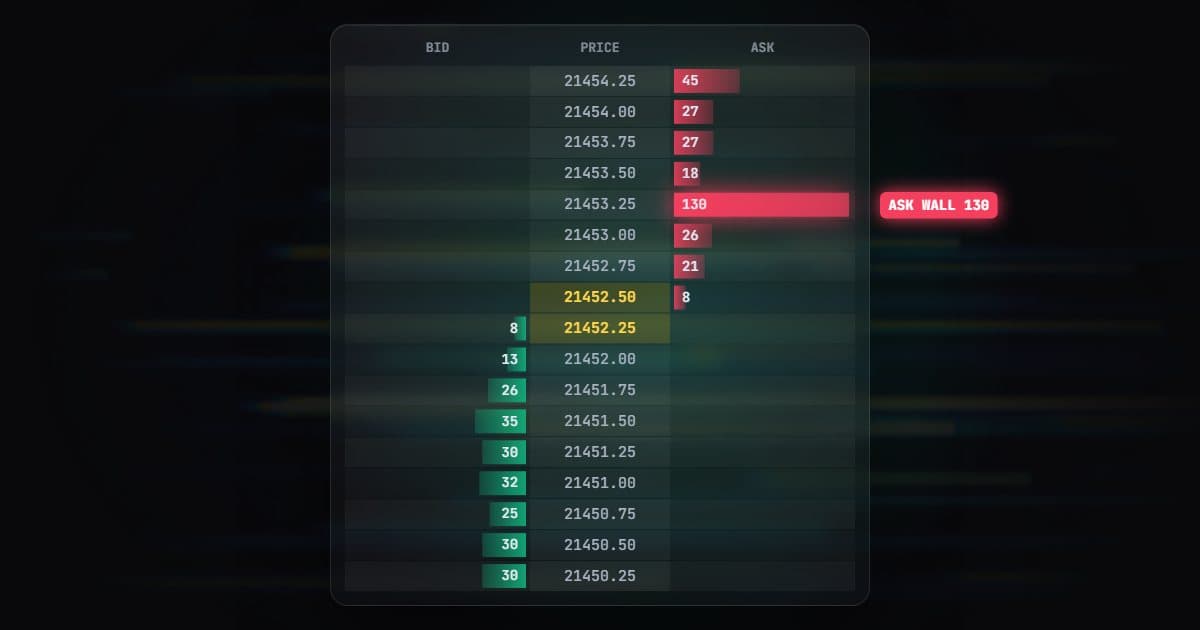
- Lopsided resting size. One side of the book holding several times more contracts than the other near the market.
- Size that appears and vanishes. A large resting order near price that is cancelled as price approaches, without trading.
A fourth pattern, absorption, sits between them: heavy aggressive volume that fails to move price because passive orders keep filling it.
From "follow the big players" to a rule
"Follow the institutions" is not something you can test. A precise definition is. Here is how the two Vantedge strategies turn those patterns into rules with numbers attached.
Vantedge FlowPilot treats a stack of 3 consecutive imbalanced price levels as its trigger. Each level needs one side at least 300% of the diagonal opposite side, with at least 10 contracts on the stronger side. That captures clustered aggression from trade data alone.
Vantedge BookPilot reads the book. Its Pressure Break signal fires when summed size on the first two levels of one side is at least 4 times the other and holds above 2.5 times for 250 ms. Its Pulled Wall signal tracks a level at least 2.2 times the size of the levels behind it, and scores it when most of that size is removed without trading.
Neither rule claims to identify an institution. Each describes a measurable event that large activity tends to cause.
Follow or fade?
Heavy aggression is not always informed. Sometimes it is a large player pushing price. Sometimes it is a crowd of stops being run into a wall of passive orders that absorbs all of it. The same footprint can lead to a trend or a snap-back.
FlowPilot handles this with its Auto mode. At each bar close it measures how closely price change has followed bar delta over the last 5 bars. A correlation of 0.6 or more puts it in the Trend regime, where it follows the stack. A correlation of 0.0 or less puts it in the Regression regime, where it fades it. The point is general: spotting large activity is half the job, and context decides which way to trade it.
A checklist for any "tracker"
Whatever product you look at, these questions separate useful tools from marketing:
- Does it define its signal in numbers you can see and change?
- Can you test it on history or in replay before paying with real losses?
- Does it claim to know who is behind an order? Public data cannot tell it that.
- Does it show what it does not see, such as hidden size or levels beyond the visible book?
- If it trades for you, are there hard daily loss limits?
The comparison page sets out what each Vantedge strategy reads, how it enters and how it can be tested, so you can apply that checklist directly.
A realistic expectation
Retail traders cannot see institutional intent, but they can measure its side effects consistently. Consistency is the real advantage of a written rule over a hunch about who is behind the tape.
Reading large-player footprints does not remove the risk of trading futures, which can exceed what you planned to lose. Prove any strategy in SIM, and in Market Replay for BookPilot, before it touches an evaluation, funded or live account.