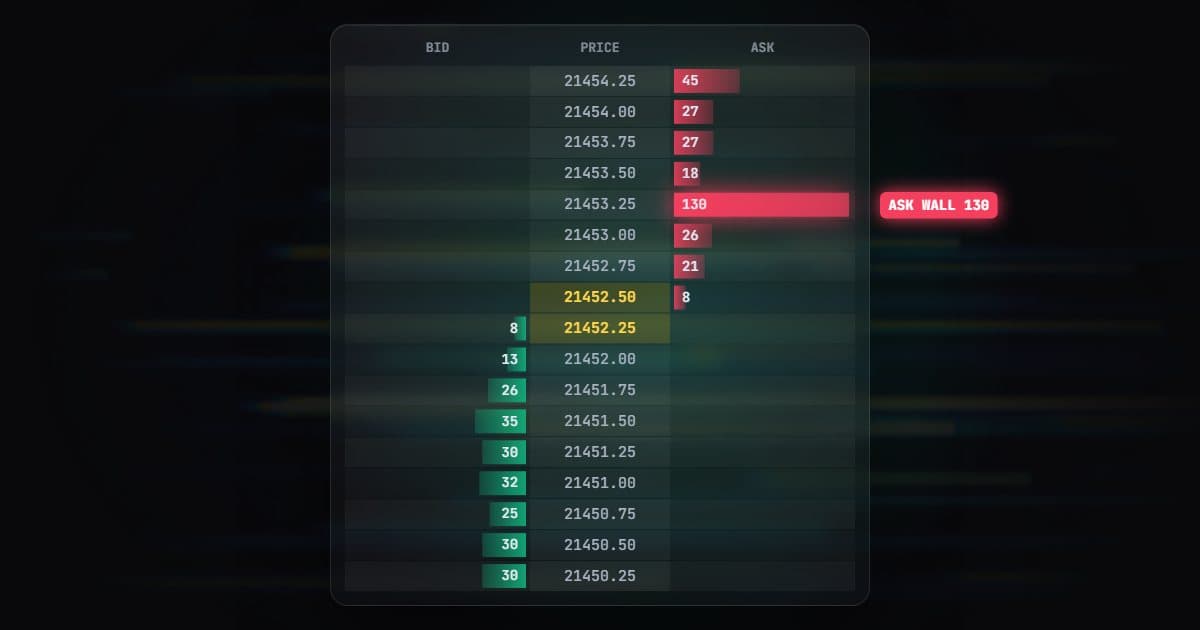
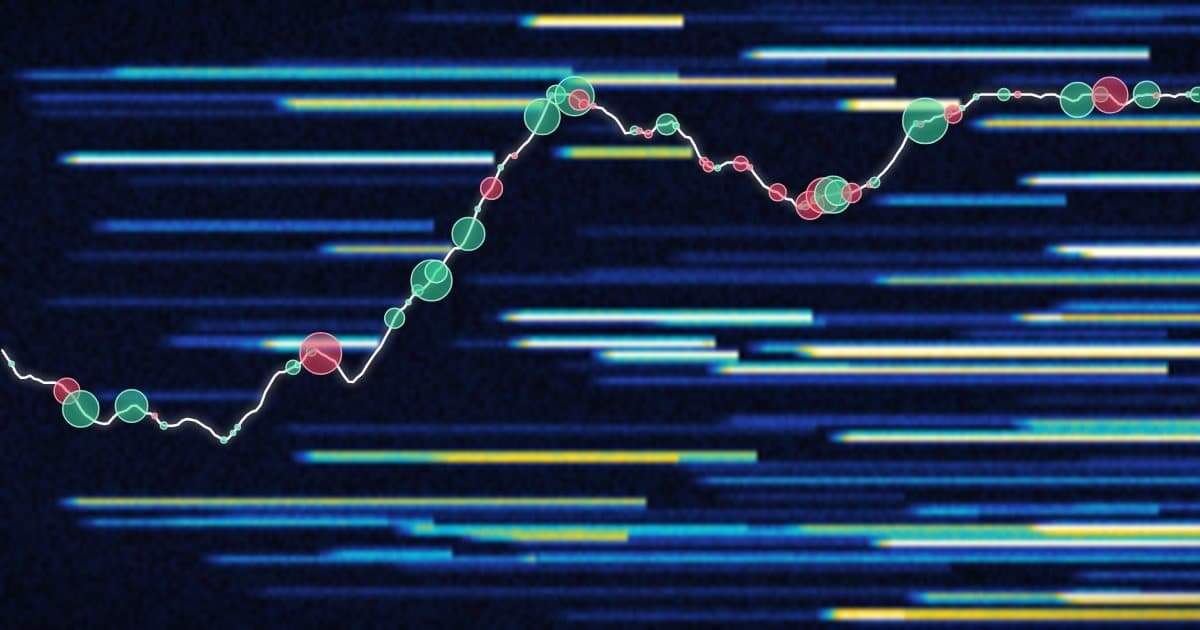
The idea is simple: if far more size is resting on the bid than on the ask, the next price move is more likely to be up. Turning that idea into a working prediction model involves a handful of careful choices. This guide walks through them, and shows how one real implementation makes each choice.
The raw signal: queue imbalance
Start at the touch, the best bid and best ask. Call the bid size B and the ask size A. The queue imbalance is (B minus A) divided by (B plus A). It runs from -1, all the size on the ask, to +1, all the size on the bid.
The intuition: the thinner queue is more likely to be eaten through first. If the ask holds 20 contracts and the bid 200, a few buy orders can clear the ask and move price up, while it would take far more selling to clear the bid.
A refinement: the microprice
The mid price ignores size. The microprice weights each side by the size on the opposite side: (bid price times A plus ask price times B) divided by (A plus B). When the bid is heavy, the microprice sits close to the ask, reflecting where the next trade is more likely. The distance between microprice and mid, the microprice offset, is a common model input.
Going deeper than the touch
Summing size across the first few levels gives a depth ratio, steadier than the touch alone. The trade-off is that deeper size is easier to place and cancel without intent to trade, so it carries more noise from spoofing. Many models use both a touch measure and a depth measure.
Adding the tape
Resting orders show intent; trades show action. The balance of recent aggressive buys and sells, over a window of prints, adds information the book alone does not have, such as whether buyers are actually lifting the ask.
From features to a probability
A logistic model is a natural fit. It takes a weighted sum of the inputs and passes it through the logistic function, which squeezes any number into a probability between 0 and 1. The weights are fitted on past data so the probabilities line up with what actually happened. It is simple, quick to evaluate on every book update, and each weight is readable.
Choosing the label
You have to define what you are predicting. A clean choice is the direction of the mid price's next move of a fixed size, say 2 ticks. That avoids fixed time windows, in which nothing happens in quiet periods and too much happens in busy ones.
Choosing the horizon
Book imbalance carries information for a very short time. Predicting the next couple of ticks is realistic; predicting the next ten minutes from the touch is not.
Pitfalls to plan for
- Non-stationarity. The relationship drifts with volatility, time of day and contract roll. Refitting regularly helps.
- Instrument differences. ES and NQ books look very different. Weights fitted on one should not be used on the other.
- Spoofed size. Imbalance built from orders that will be cancelled misleads the model. Filtering for pulled walls helps.
- Calibration. A model that says 0.70 should be right about 70% of the time at that reading. Check it.
- Edge versus cost. A small shift in short-horizon odds can be smaller than the spread and commission. A prediction is not a profitable trade.
One implementation: BookPilot's Micro-Forecast
Vantedge BookPilot and its BookScope indicator use a model built along these lines:
- Label: the direction of the mid price's next 2-tick move, output as P up.
- Inputs: queue imbalance at the touch, microprice offset, the buy/sell balance of the last Flow Window prints (50 by default) and the Pressure Break ratio.
- Model: logistic, starting from built-in weights.
- Fitting: after about 1,600 labelled samples it fits its own weights for the instrument, and refits every 200 new samples. The model is saved per instrument.
- Use: as a confirmation filter for signals (Confirm Threshold 0.55 by default), to set a Long, Short or None bias, and optionally for early exits.
It addresses several pitfalls above directly: per-instrument models, regular refitting, and a separate scanner that vetoes Pressure Break signals while the book's spoof score is 0.6 or higher. It does not remove the cost problem, which is why it is used as a filter on other signals rather than as a signal on its own. The BookPilot guide documents every setting, and the glossary covers the terms.
A well-built prediction model still trades into real futures risk. Validate any model-driven strategy in Market Replay and SIM before using it on an evaluation, funded or live account.