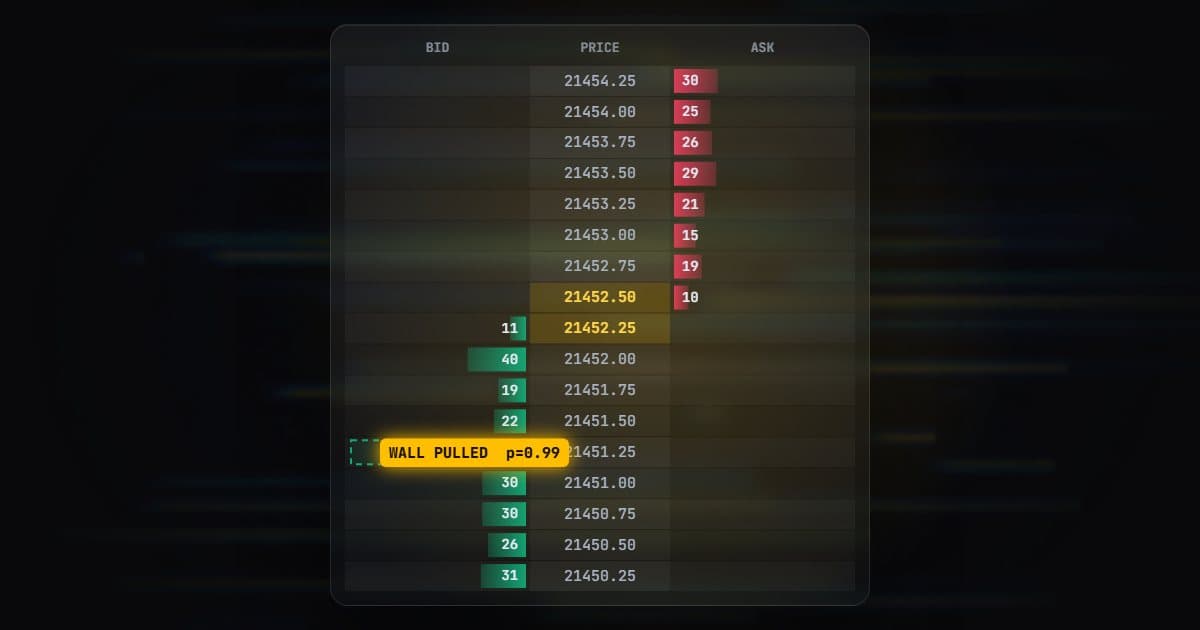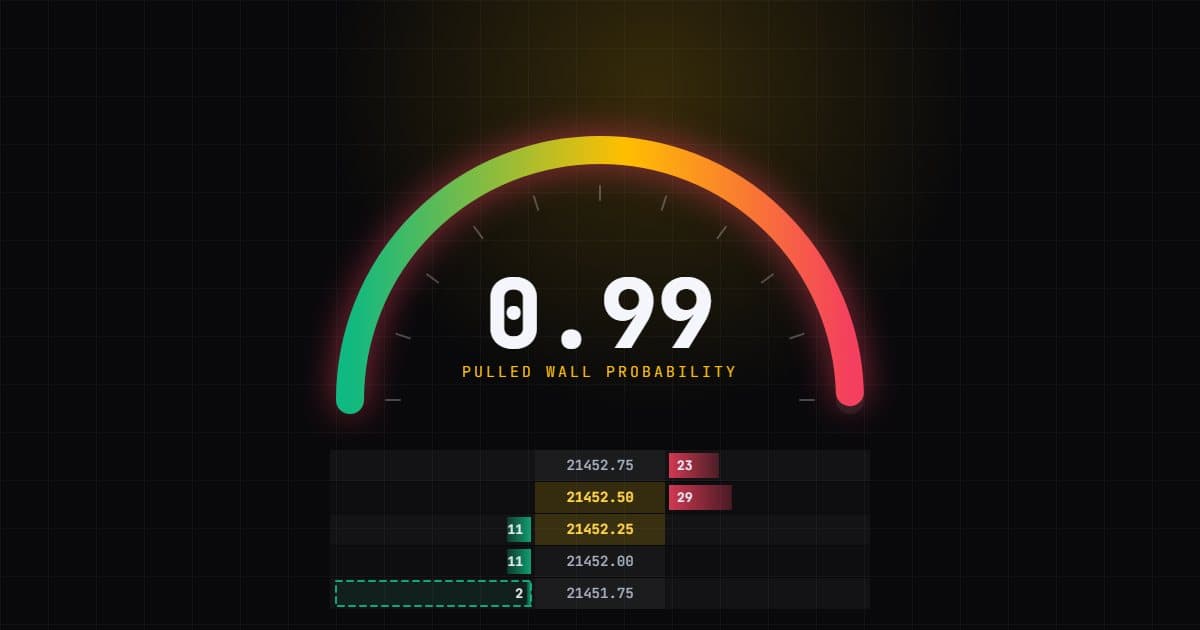
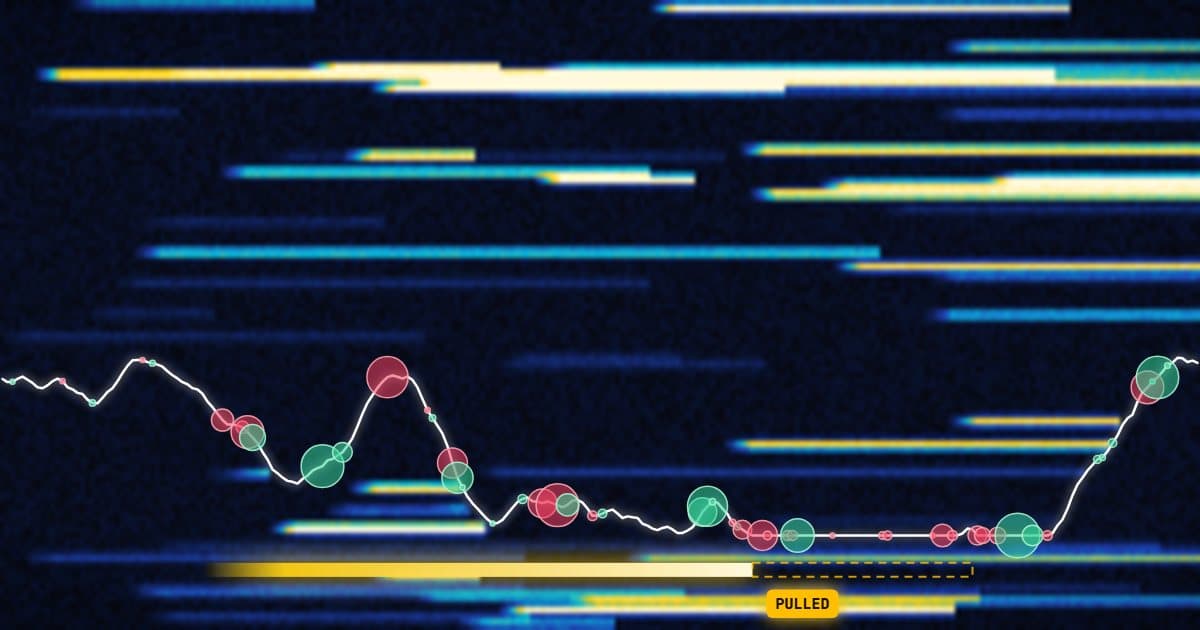
A spoof score tries to answer one narrow question with a number: when a large resting order disappears from the book without trading, how much did it look like an order that was never meant to fill? This article takes apart the score used by the Pulled Wall scanner in Vantedge BookScope and BookPilot, one component at a time.
Why a score instead of a yes or no
Nobody outside the exchange and the regulators can see the intent behind an order. Pulling an order is normal: quotes get adjusted all day.
What you can measure is behaviour. How big was the order compared with its neighbours? How close did price come? How long did it live? How often did its size change? What traded while it was there? A score turns those observations into one value between 0.0 and 1.0, so you can set a threshold and compare one event with the next.
That makes the score a diagnostic, not a verdict. A reading of 0.8 does not mean "80% chance this was illegal". It means the pull matched more of the patterns that spoofed walls tend to show.
Step one: is it a wall at all?
Before anything is scored, the scanner has to decide that a level is a wall. In BookPilot a level qualifies when its size is at least Pulled Wall Ratio times the average size of the levels behind it. The default ratio is 2.2. That baseline average runs from the Split Depth level (default 2, with the best bid or ask counted as 0) out to the 10th level.
Which levels are scanned is set by Start Depth (default 2) and Pulled Wall Depth (default 4). With the defaults, that is the 3rd and 4th levels from the inside. The touch itself is skipped by default because size there changes constantly.
A wall then has to lose at least Pull Fraction of its peak size without trading for the event to count as a pull. The default is 0.6, so 60% of the peak has to vanish. Walls tracked for longer than Max Wall Age (default 30,000 ms) are dropped from tracking.
The five components
| Component | Adds | When it applies |
|---|---|---|
| Base | 0.35 | Any qualifying wall that is pulled |
| Approached | +0.20 | Price came within Approach ticks of the wall (default 2) |
| Short life | +0.15 | The wall lived for less than 5 seconds |
| Frequent size changes | +0.15 | Its size was changed often while it rested |
| Opposite aggressive volume | +0.15 | Aggressive volume traded on the opposite side |
All five together add up to 1.0.
Three worked examples
Take the default Fire Probability of 0.6, the minimum score a pulled wall needs before BookPilot will trade it.
- The quiet pull. An ask wall sits at the 3rd level for 12 seconds. Price never gets within 2 ticks, the size hardly changes, and it is then pulled. Score: 0.35. No signal.
- The fast, approached pull. The same wall appears, price ticks up to within 2 ticks of it, and it is gone after 3 seconds. Score: 0.35 + 0.20 + 0.15 = 0.70. That clears 0.6, and because an ask wall was pulled, the signal is long.
- The borderline case. A bid wall is approached and pulled after 20 seconds with nothing else unusual. Score: 0.35 + 0.20 = 0.55. Just under the default, so no trade.
The third example shows why the threshold matters. The BookPilot guide points out that at a Fire Probability of 0.55 or lower, any approached pull qualifies on its own.
What the score does inside BookPilot
Above Fire Probability, the Pulled Wall signal trades against the wall that disappeared. A pulled bid wall means sell, and a pulled ask wall means buy. The idea is that the wall was propping up the impression of support or resistance, and that impression has just gone.
The book's spoof score also acts on the other signal engine. A Pressure Break is vetoed while the spoof score is 0.6 or higher, because the lopsided book behind it is probably not real. With Risk Tolerance set to Low or Medium, a rising spoof score can also close a Pressure Break trade early.
A high score alone does not place an order. The signal still has to pass Forecast Confirm (when it is on), the Rules of Engagement, the trading hours and the risk preset's hourly cap.
Tuning it without fooling yourself
- Fire Probability: the guide suggests 0.55 to 0.75. The Conservative profile uses 0.70, Active uses 0.55.
- Pull Fraction: higher values only count near-complete pulls. Lower values start to count ordinary order management.
- Approach: a larger value hands out the +0.20 bonus more easily, which pushes more pulls over the line.
BookPilot cannot be optimised in the Strategy Analyzer, because historical bars carry no order book. Tune it in Market Replay on the same days each time, and change one setting per run. The BookPilot user guide lists every range.
What the score cannot see
The score only knows about displayed depth. Hidden or iceberg size is invisible to it, and a genuine trader who cancels quickly gets scored exactly like a spoofer. Treat it as one input to a trading decision, not as evidence about anyone. The glossary covers the related terms, and the BookPilot product page shows what is included.
Futures can lose you more than you expect, and a spoof score does not change that. Run BookPilot in SIM and Market Replay first, and only then decide whether it belongs on an evaluation, funded or live account.