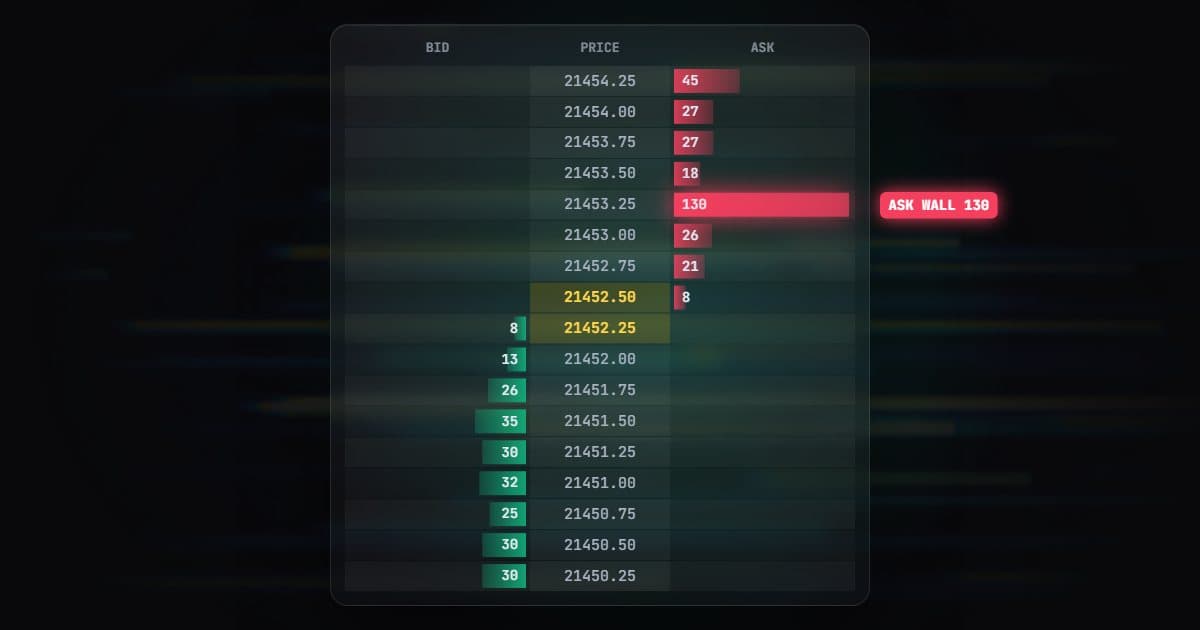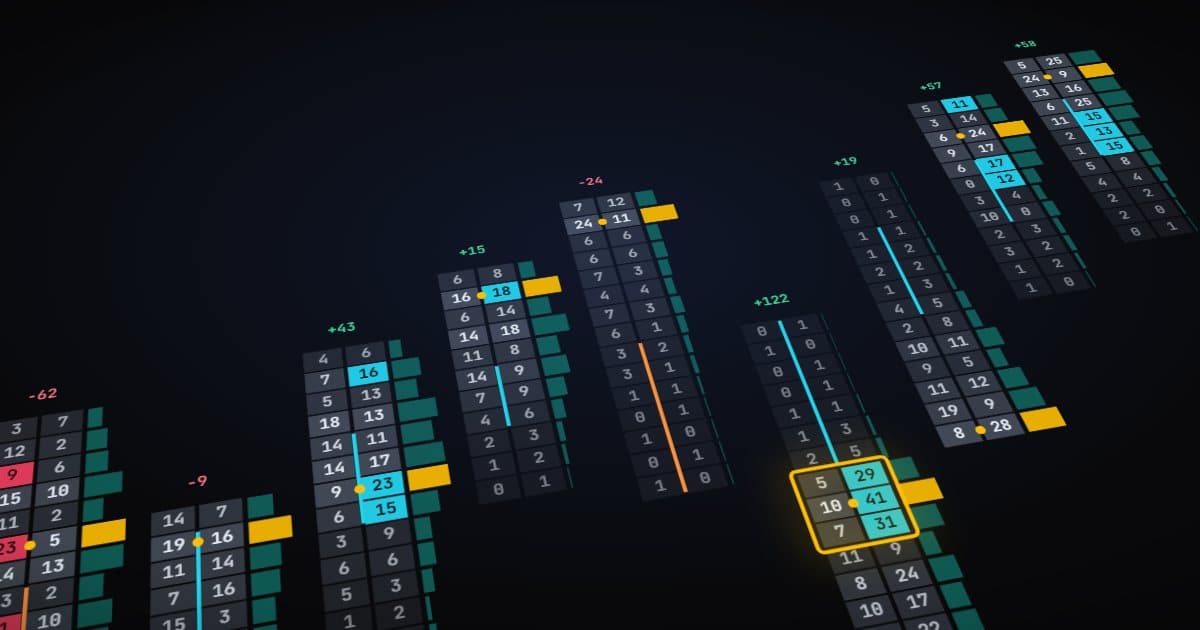
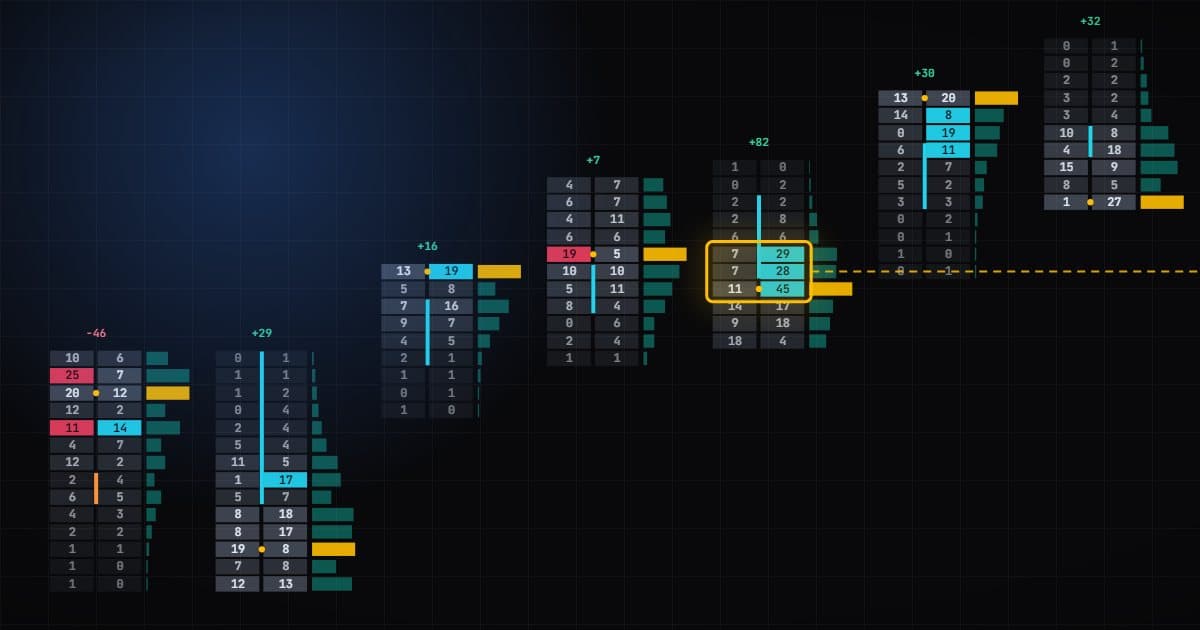
"Imbalance alert" means two different things depending on who you ask. One trader means lopsided traded volume in a footprint bar. Another means lopsided resting size in the order book. They are measured differently, happen on different timescales and lead to different trades.
Traded imbalance: the footprint
A footprint splits each bar's volume by price into trades that hit the bid (sellers) and trades that lifted the ask (buyers). An imbalance compares the two diagonally: buying at one price against selling one level lower, because those two prices were the ask and bid at the same moment.
A worked example: at one price, 96 contracts traded on the ask. One level below, 30 traded on the bid. The ratio is 3.2. With a 300% threshold and a minimum of 10 contracts on the stronger side, that level is a buying imbalance. When three or more such levels line up, you have a stacked imbalance: buyers pushed through several prices in a row.
Resting imbalance: the order book
The book version looks at orders that have not traded. Add up the size on the first few bid levels and on the first few ask levels, and compare. If the bid side holds 220 contracts and the ask side 50, the book is leaning roughly 4.4 to 1 toward buyers.
This kind of imbalance comes before price moves, and it can disappear just as quickly, because resting orders can be cancelled at any time.
Why "real-time" matters for both
An alert that fires at bar close is late for a footprint stack that completed two minutes earlier. Vantedge FlowPilot checks the forming bar's footprint on every trade, not only when the bar closes, so its trigger fires the moment the third level qualifies.
Book imbalance needs the opposite protection: not speed, but patience. BookPilot's Pressure Break requires the imbalance to start at 4 times or more and hold above 2.5 times for 250 ms before it counts. Without that hold, flickering size would produce an alert every few seconds.
Alerts in the included indicators
The two Vantedge plans include indicators that show these imbalances on screen:
- Vantedge Footprint (both plans) highlights bid/ask volume imbalances at configurable ratio thresholds, such as 3:1 or 4:1, shows footprint cells with delta shading, and includes cumulative delta divergence alerts.
- Vantedge BookScope (BookPilot plan) shows signal markers and alerts for Pressure Break and Pulled Wall, and an on-chart DOM ladder that flashes in the colour of the engine that fired.
From alert to trade
An alert asks you to decide. A strategy decides for you, but only after more conditions than the imbalance itself. For FlowPilot, a stack becomes an order only when:
- The bar's delta agrees with the stack (with Require Congruent Delta on).
- The mode picks a direction: Follow, Fade, or Auto choosing between the Trend and Regression regimes.
- That direction is armed and allowed by the Trend Long and Trend Short filters.
- The daily gate is open, with no goal or max-loss lock and no cooldown running.
A bar that holds both a bullish and a bearish stack is skipped. Each of these conditions is a reason a visible imbalance does not produce a trade, which is worth knowing before you compare alerts with fills.
Keeping alerts useful
The most common problem is too many alerts. On the footprint side, the FlowPilot guide notes that below an Imbalance Ratio of about 2.0 most busy bars contain stacks, so they stop meaning anything. On the book side, a Pressure Break Ratio below about 2.5 fires on ordinary noise. Start strict, and loosen only when you can see what you are missing.
Also match the bar type and size between your alert chart and any testing you do. Larger bars collect more volume and contain more stacks. The FlowPilot user guide explains each signal setting and what raising or lowering it does, and the BookPilot page covers the book-side tools.
An imbalance alert tells you where pressure was, not where price will go, and futures can move hard against you. Validate any alert-driven or automated approach in SIM, and Market Replay for book signals, before trading an evaluation, funded or live account.