"High-frequency" sounds like an edge. For a retail trader on NinjaTrader 8, it mostly describes how often an indicator updates, not how fast you can act. Understanding that gap is the key to using tick-by-tick order flow sensibly instead of chasing speed you cannot have.
What high-frequency means in practice
An order flow indicator can work at three speeds:
- Per bar. It recalculates when a bar closes. Simple and stable, but late.
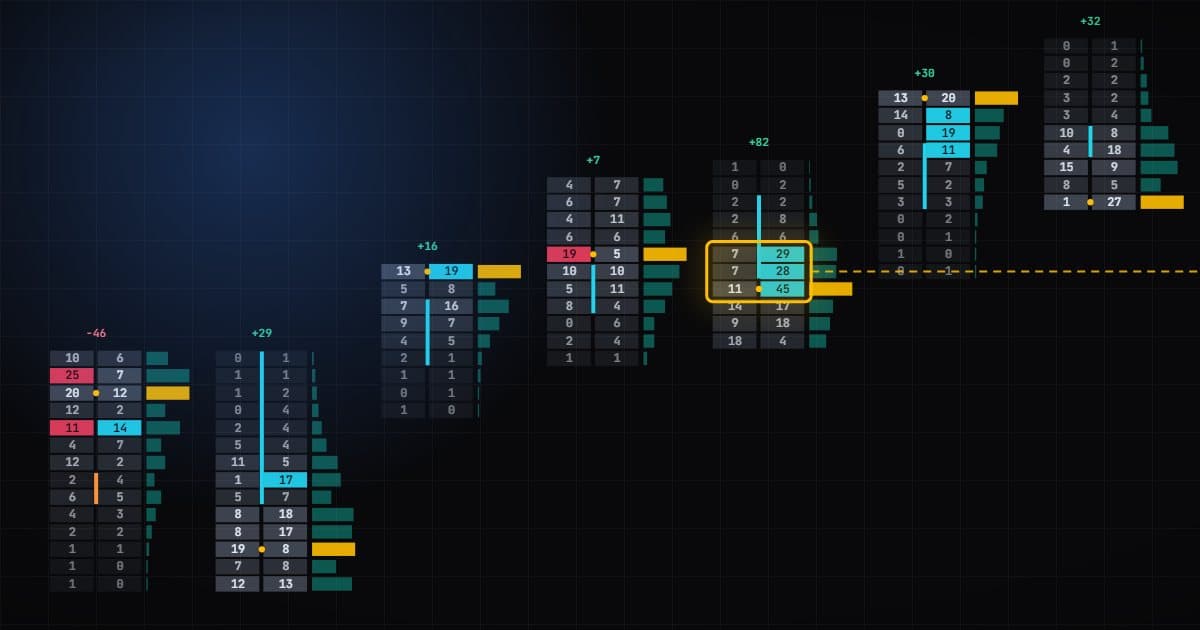
- Per trade. It recalculates on every print. Needed for anything built on the footprint of the bar that is still forming.
- Per book update. It recalculates every time resting size changes at any visible level. In busy markets that can be many times a second.
"High-frequency" indicators are the last two. They see events as they arrive, timed to the millisecond.
The latency chain
Professional high-frequency firms place their servers next to the exchange and measure delays in microseconds. A retail setup has a much longer chain:
- Exchange to data provider.
- Data provider to your computer, over the internet.
- NinjaTrader processing the update and running your indicator or strategy.
- Your order travelling back through your broker to the exchange.
Each step adds delay. By the time a retail order arrives, the fastest participants have already reacted to the same event. Any approach that depends on being first will lose that race.
Designing around being slower
The useful question is not how to be faster but which signals still work when you are not the fastest. A few principles:
- Require persistence. A condition that has to hold for a short time filters flickers that the fastest traders create and remove before you can act.
- Use limit orders where possible. Waiting for price to come to you avoids paying up into a move you are late for. The cost is that some trades never fill.
- Cancel stale orders. If an entry has not filled quickly, the reason for it may be gone.
- Prefer short-horizon probabilities over certainties. At this speed the honest output is a lean in the odds, not a prediction.
- Keep the platform light. Every heavy indicator on the same machine competes for processing time.
How the Vantedge strategies apply this
FlowPilot: per trade
FlowPilot checks the footprint of the forming bar on every trade, not only at bar close. It sets NinjaTrader's Calculate mode to On each tick by itself because the footprint needs every trade. Its signal, a stack of imbalances across several price levels, builds up over a bar, so it does not depend on millisecond timing. It enters at market and holds to a tick bracket.
BookPilot: per book update
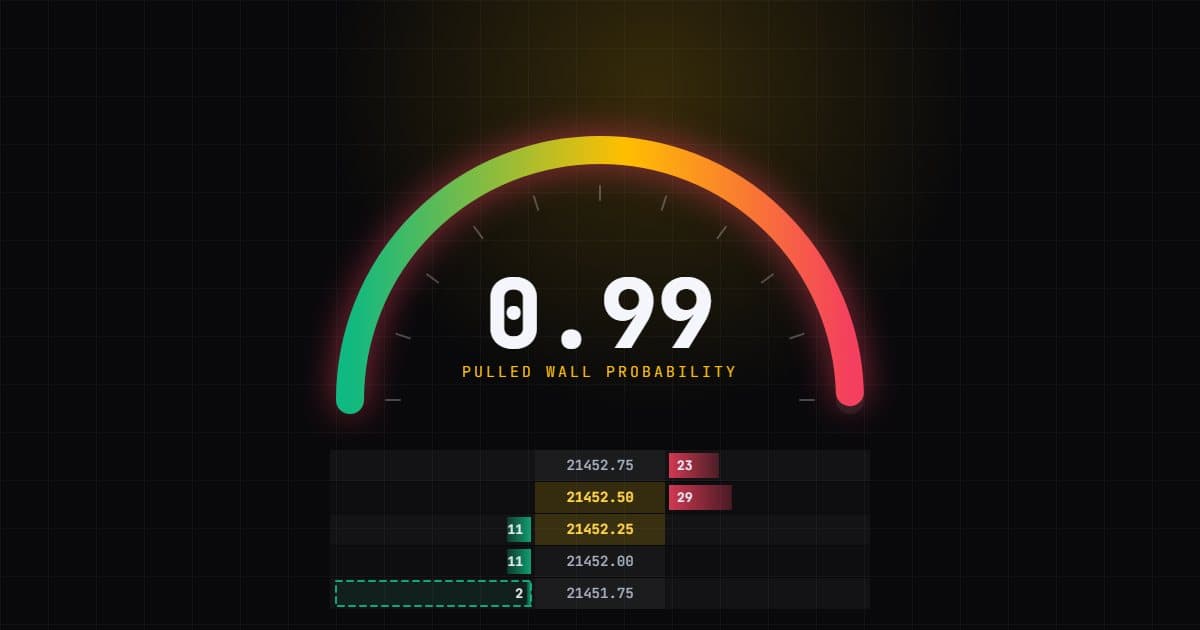
BookPilot reads the Level 2 book tick by tick and reacts within milliseconds. It uses the principles above directly:
- Persistence: a Pressure Break candidate must hold its ratio for Confirm, 250 ms by default, before firing.
- Limit entries: orders are placed a few ticks behind the best bid or ask rather than at market.
- Stale-order cancel: unfilled entries are cancelled after 3 seconds, or if price runs away by the Cancel ticks.
- Probabilities: a 2-tick Micro-Forecast confirms signals rather than generating them.
- Stale data check: it refuses to arm if no Level 2 update has arrived in the last 5 seconds.
Data quality matters more than speed
A per-update indicator is only as good as the updates it receives. A feed that aggregates or drops depth updates will show a smoother, slower book than the real one. Check your feed's depth and update behaviour, and test with recorded data in Market Replay so that you know what the indicator does with your actual feed. The FlowPilot vs BookPilot comparison lists the data each strategy needs.
Signs you are chasing speed
- Most of your losses come from entries that filled just as the move reversed.
- Results in replay look far better than live, where fills are worse.
- You keep shortening confirmation windows to get in earlier.
Each of these points to a design that depends on being faster than you are. Lengthening confirmation, deepening limit offsets carefully or switching to bar-level signals are usually better fixes than more hardware.
Fast indicators can lose money just as fast in leveraged futures. Test any tick-level approach in SIM, and in Market Replay for book-based strategies, before an evaluation, funded or live account.