
Plenty of tools claim to "detect spoofing". Some only colour large orders on a ladder. Others follow each large order from the moment it appears until it trades or disappears. Before you pay for any of them, it helps to know what the job actually involves and which questions sort the useful tools from the decorative ones.
The four jobs detection software has to do
Whatever the marketing says, software that flags spoofed liquidity has to do four things, in order.
- Find candidates. Decide which resting orders are big enough to matter, compared with the rest of the book rather than in absolute contracts.
- Track them over time. A single snapshot of the book cannot show a pull. The tool has to remember each candidate and see what happens to it.
- Classify the outcome. Did the order trade, get pulled, or just age out? Only a pull without trading is interesting here.
- Rate and act. Turn the pull into a score, then alert you, draw it, or trade it.
A tool that skips the second step is a heatmap, not a detector. That can still be useful, but it is a different product.
Questions to ask before buying
How is "large" defined?
A fixed size such as "over 200 contracts" behaves very differently on ES and NQ, and at the open versus lunchtime. A relative rule adapts. BookScope and BookPilot, for example, compare a level with the average of the levels behind it (Pulled Wall Ratio, default 2.2).
Can you see why something was flagged?
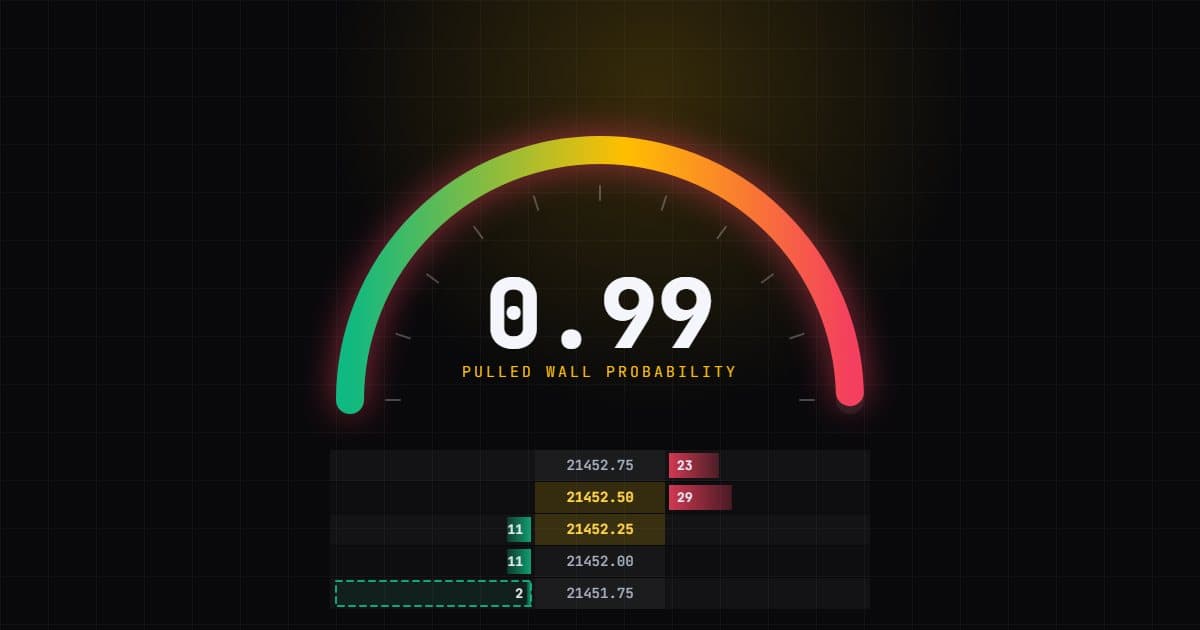
A black-box "spoof meter" is hard to trust and impossible to tune. Prefer a score built from named parts. The Vantedge Pulled Wall score starts at 0.35 and adds fixed amounts for an approached wall, a short life, frequent size changes and opposite aggressive volume, so every reading can be explained.
Which levels does it watch?
Size at the best bid and ask changes constantly, so watching the touch produces a lot of noise. Tools that let you set a scan band, such as Start Depth and Pulled Wall Depth in BookPilot, give you control over that trade-off.
What data does it need?
Any real spoof detector needs a Level 2 market depth feed. If a product claims to spot spoofing from candles or the footprint alone, ask how. Traded volume shows what happened, not what was offered and withdrawn.
Can you test it on past sessions?
Historical bars in NinjaTrader carry no order book, so a depth-based tool cannot be backtested in the Strategy Analyzer. Market Replay with downloaded depth data is the practical substitute. Ask whether the tool behaves correctly when you rewind or skip in replay.
Showing a pull versus trading it
This is the biggest dividing line. A display tool leaves the decision and the click to you, and pulls often happen in well under a second. An automated strategy takes the decision out of your hands but adds its own rules.
Vantedge covers both sides in one plan. Vantedge BookScope is the visual part: tracked-wall boxes with pull marks, an on-chart DOM ladder that flashes in the colour of the engine that fired, signal markers and alerts, plus a forecast and bias info box. Vantedge BookPilot is the automated strategy that trades the fade: when a pulled wall's spoof probability clears Fire Probability (default 0.6), it enters against the wall with a limit order a tick behind the touch by default.
Both come in the same $399 a month plan, together with Vantedge Footprint and the Vantedge DOM Pressure Matrix, a SuperDOM column for depth ratios and thinning warnings. The BookPilot product page has the full list.
What good detection software will not claim
- That it proves manipulation. A score describes behaviour. It is not a legal finding.
- That it sees everything. Hidden and iceberg orders never appear in the displayed book.
- That fading pulls is profitable by itself. A pull is information, not an edge on its own, which is why BookPilot runs every signal through confirmation, Rules of Engagement and daily limits.
If a vendor's page reads like a promise of profits, treat that as a reason to look elsewhere.
Matching the tool to how you trade
If you trade by hand from a ladder and want context, a visual detector is enough. If you want the reaction automated with fixed brackets and hard daily limits, you need a strategy, and you should compare its execution rules as carefully as its detection. The FlowPilot vs BookPilot comparison helps if you are still deciding whether you need Level 2 at all.
No detector removes the risk of trading futures. Prove the setup on SIM and in Market Replay before any evaluation, funded or live account sees an order from it.