Order books do not look the same all day. Sometimes both sides are thick and calm, sometimes one side is stacked, sometimes size drains away. Naming these states, or phases, helps you decide when book-based signals are worth trusting.
Why think in phases at all
A single snapshot of the depth ladder is easy to misread. Three hundred contracts on the bid means one thing when the ask holds three hundred too, and something else when the ask holds forty. Thinking in phases forces you to look at the whole book and at how it is changing, not at one number.
The labels below are a practical framework, not an industry standard. Use them to organise what you see.
Five observable states
Balanced
Both sides hold similar size near price, and that size refills as it trades. Price tends to rotate within a few ticks. This two-sided book is the environment many book scalpers prefer, because signals stand out against a stable background.
Lopsided
One side holds several times more resting size than the other on the first few levels. Price often leans away from the heavy side, as the thin side gives way more easily. The key question is whether the imbalance lasts or flickers.
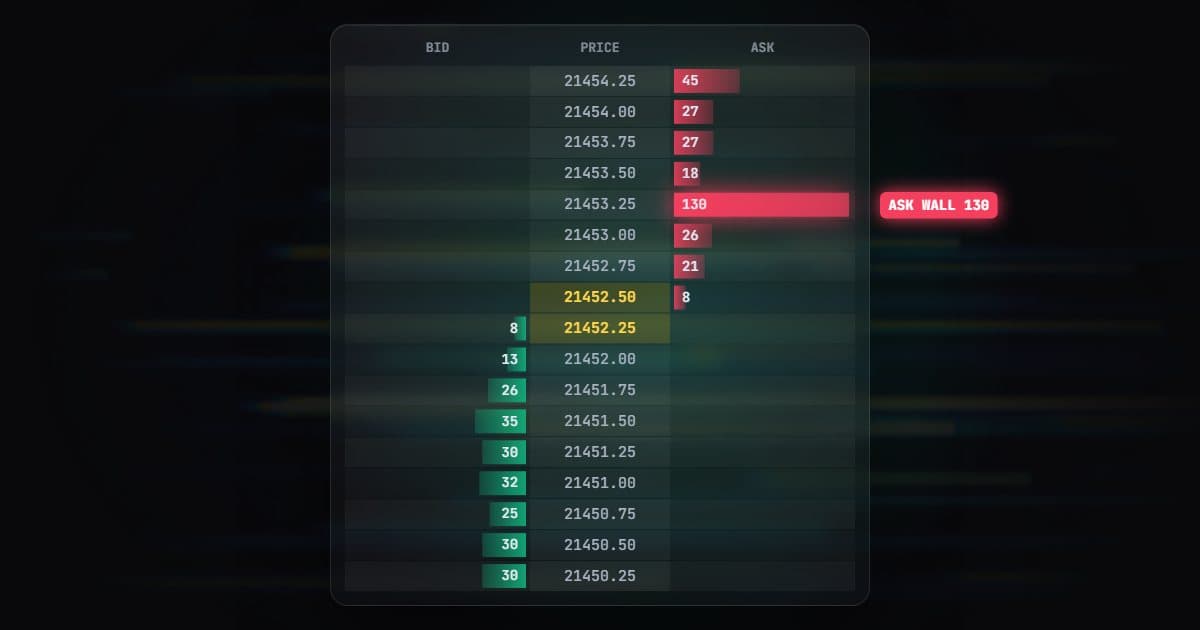
Walled
A single level, usually a few ticks from price, holds far more than the levels around it. It may be a genuine large order, or it may be there to influence other traders.
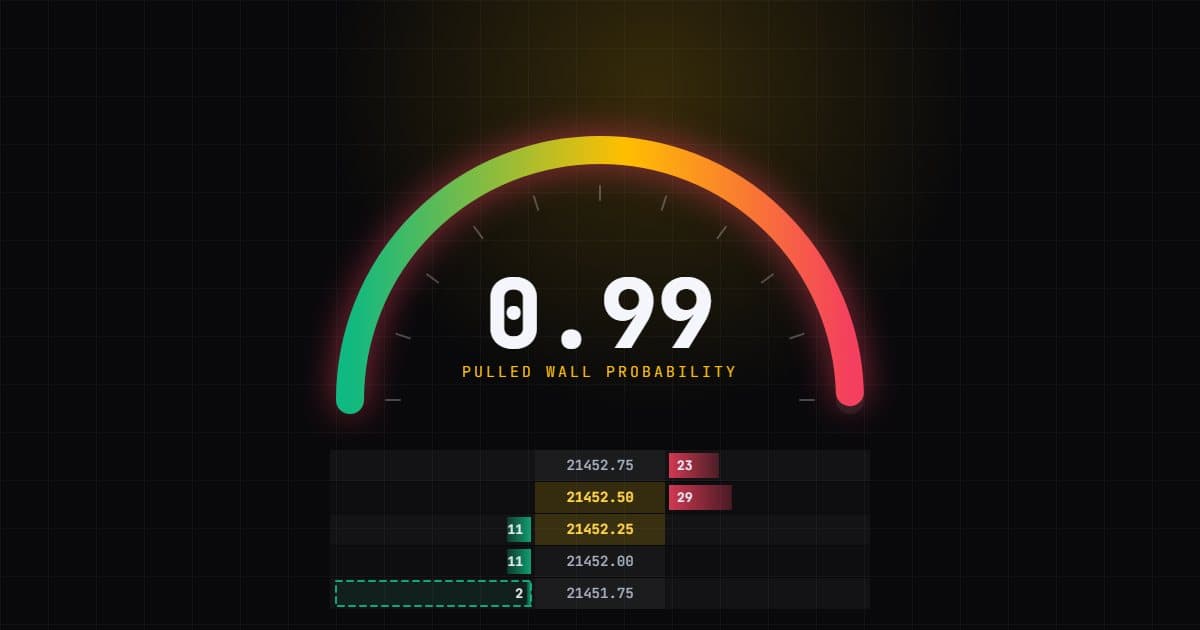
Pulled
The wall disappears without trading, often as price gets close. This transition is short, but it is one of the most informative events in the book.
Thinning
Size drains from one side across several levels at once. Price can then move several ticks on little volume. Thin books are common around news and outside the main session.
Watch the transitions
The states matter most at the moment one turns into another. A lopsided book either holds or fades. A walled level is either filled, which means the size was real, or pulled, which means it was not. A balanced book that starts thinning is a warning that rotation may give way to a fast move.
When you practise, write down the transition, not just the state. "Bid went from 4 to 1 times the ask in two seconds" is something you can test later. "The bid looked strong" is not.
How this maps to BookPilot
Vantedge BookPilot does not label phases. It trades two specific transitions with fixed rules:
- Lopsided, and holding: the Pressure Break signal. The first 2 levels of one side must hold at least 4 times the other, and stay above 2.5 times for 250 ms.
- Walled, then pulled: the Pulled Wall signal. A level at least 2.2 times the baseline loses most of its size without trading, gets a spoof probability, and is faded above 0.6.
Balance is the backdrop: the product is described as suited to rotational, two-sided markets. Its default trading window of 08:30 to 15:00 exchange time avoids the thinner overnight books. Thinning is not a BookPilot entry signal. Level-thinning warnings are shown by the Vantedge DOM Pressure Matrix, a SuperDOM column (not a chart indicator) included with BookPilot, so you can watch for it yourself.
The comparison page shows how this differs from FlowPilot, which reads traded volume and ignores resting size altogether.
A practice routine
- Load a few days of ES or NQ Market Replay data, which includes depth.
- Replay the first hour of the cash session at normal speed and note each time the book changes state.
- For each transition, note what price did over the next minute.
- Compare your notes with where BookScope, the Level 2 indicator in the BookPilot plan, marked Pressure Break and Pulled Wall signals.
After a few sessions you will have your own view of which transitions carry information on your instrument. Terms used here, such as market depth and the touch, are defined in the glossary.
Recognising book phases improves your reading but cannot remove the risk of loss in futures. Practise in Market Replay and SIM before any evaluation, funded or live account.